料理仙姬
Politics-driven Graham-named Russia sanctions bill exposes US political coercion in global energy supply chains: expert_我的网站

A | New Delhi, Oct 17 (UNI) Prime Minister Narendra Modi on Monday released the 12th instalment amount of Rs 16,000 crore to eligible farmers under the Pradhan Mantri Kisan Samman Nidhi (PM-KISAN) through Direct Benefit Transfer.
He inaugurated a two-day event 'PM Kisan Samman Sammelan' at Indian Agricultural Research Institute.
Addressing the gathering, the prime minister said, "I congratulate the farmers and their family members for having received the 12th installment today under Pradhan Mantri Kisan Samman Nidhi through Direct Benefit Transfer ahead of Deepawali."
Under the scheme, eligible farmer families are provided a benefit of Rs 6000 per year in three equal instalments of Rs 2,000 each.
So far, eligible farmer families have received benefits of more than Rs 2 lakh crore under PM-KISAN.
The Prime Minister termed the scheme a transformational initiative.
During the event, Modi also inaugurated 600 Pradan Mantri Kisan Samruddhi Kendras (PMKSK) under the Ministry of Chemicals and Fertilizers.
Under the scheme, the fertilizer retail shops in the country will be converted into Pradan Mantri Kisan Samruddhi Kendras in a phased manner.
Pradan Mantri Kisan Samruddhi Kendras will cater to a wide variety of needs of the farmers and provide agri-inputs (fertilizers, seeds, implements); testing facilities for soil, seeds, fertilizers; generate awareness among farmers; provide information regarding various government schemes and ensure regular capacity building of retailers at block and district level outlets, the PMO said.
More than 3 lakh retail fertilizer shops are planned to be converted into PMKSK.
"From today, the work will start to convert over 3.15 lakh fertilizer shops into Pradhan Mantri Samruddhi Kendras. These Kendras will be a one stop solution catering to all requirements of our annadatas," the Prime Minister said.
The Prime Minister also launched Bharat Urea Bags, which will help companies market fertilizers under the single brand name Bharat.
"Through One Nation One Fertilizer, urea will now be available under one brand name - Bharat. This will ensure farmers do not undergo confusion and there is consistency in the quality of fertilizers," the Prime Minister said.
The Prime Minister also inaugurated the Agri Startup Conclave and Exhibition.
About 300 startups will showcase their innovation related to Precision Farming, Post-Harvest and Value Add Solutions, Allied Agriculture, Waste to Wealth, Mechanisation for Small Farmers, Supply Chain Management, Argi-Logistic, among others.
The platform would facilitate startups to interact with farmers, FPOs, agri-experts, corporates etc. Startups will also share their experience and interact with other stakeholders in technical sessions.
During the event, Modi also launched ‘Indian Edge’, an e-magazine on fertilizer.
It will provide information on domestic and international fertilizer scenarios, including recent developments, price trends analysis, availability and consumption, success stories of farmers, among others.
UNI ASU SY。
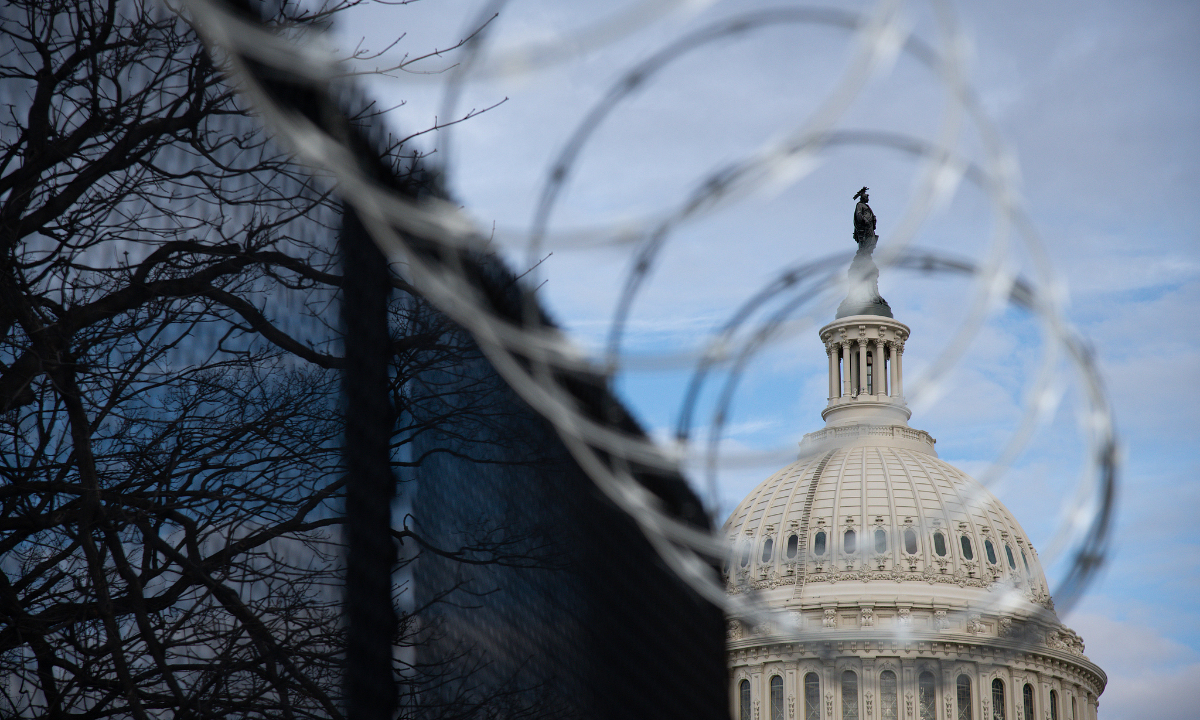
File picture of US Capitol. Photo: VCG
The US Senate on Friday overwhelmingly approved a bill that would impose sanctions on buyers of Russian oil, a measure that had long been championed by the late senator Lindsey Graham before his death last month, CNBC reported. A Chinese expert criticized the legislation, warning that if implemented, the bill, driven largely by political motives aimed at catering to US domestic political correctness, could severely disrupt the already fragile global energy market and economy. He also noted that the bill is essentially a tool of political coercion, weaponizing tariffs and unilateral sanctions to hijack normal global energy trade and override sovereign economic choices of independent nations.
The legislation, named The Lindsey O. Graham Sanctioning Russia and Iran Act of 2026, aims to hurt Russia's war effort in Ukraine by penalizing purchasers of Russian oil and Russian leaders. It passed with bipartisan support 86-11 and will now proceed to the House, which is on recess until September, per CNBC.
The bill would impose tariffs of up to 100 percent on countries that are among the top five purchasers of Russian crude oil or gas, which includes China and India.
It also includes sanctions targeting Russian leaders, officials, targeting Russian leaders, oligarchs and financial institutions. At the request of US President Donald Trump, the bill extends sanctions on Iran's weapons and energy sectors, CNBC reported.
Notably, the bill's excessive tariff discretion has sparked fierce internal doubts within US political circles. Representatives Gregory Meeks of New York and Don Beyer of Virginia said in a statement they still had "fundamental concerns" about the tariff powers for the president, who has made them a central piece of his "America First" approach to foreign policy.
"What the bill does grant ... are sweeping new tariff authorities that the president could weaponize with abandon, as he has repeatedly done in the past," said Meeks, the top Democrat on the House Foreign Affairs Committee, and Beyer, the senior Democrat on the Joint Economic Committee, according to Reuters.
Chinese experts have strongly criticized the bill's politically driven nature, its economic coercion, and its severe spillover risks to the global economy.
The bill, aimed at putting pressure on Russia, would disrupt global energy markets and create new uncertainties for the world economy if implemented, Yang Jin, associate research fellow at the Institute of Russian, Eastern European and Central Asian Studies under the Chinese Academy of Social Sciences, told the Global Times.
Many economies retain legitimate, market-based energy cooperation with Russia out of practical economic and energy security needs. Russia's energy exports have long been a key component of the global energy system, with countries including India and some European nations continuing to rely on Russian oil and gas, said Yang, noting that even some European countries have received exemptions to maintain energy imports from Russia, underscoring the role of Russian supplies in supporting economic stability.
India's reliance on Russian crude increased further after the conflict in West Asia disrupted shipping through the Strait of Hormuz. With Gulf supplies affected during the US war on Iran, Indian refiners turned more heavily towards Russian oil as an alternative source, Indian media Hindustan Times reported on Saturday after US Senate passed the bill.
When asked about the bill on July 15, Lin Jian, spokesperson from China's Ministry of Foreign Affairs said that China firmly opposes unilateral sanctions that have no basis in international law or authorization of the UN Security Council, and will take necessary measures to firmly defend the legitimate rights and interests of Chinese businesses and citizens.
Practicing double standards and resorting to coercion and pressuring will eventually prove to be self-defeating, said Lin.
Yang further pointed out that the push for the bill, labeled after Lindsey Graham, who was known as one of the toughest Russia hawks in Washington, lays bare Washington's distorted domestic political logic.
The legislation, which represents another typical case of US hegemonic long-arm jurisdiction, is largely designed to ease US domestic governance pressure. As the Trump administration fails to deliver substantive progress in de-escalating the Russia-Ukraine conflict as promised, ramping up external sanctions and forcing third-party sovereign countries into abandoning normal economic and trade cooperation has become a convenient political tool for US politicians to showcase tough posturing and ease domestic pressure, Yang said.
。
Current article:http://bae36ns.jueniaolunhuaishewo.cfd/slu/tckv.html
Published on:16:05:20